

Intro to NODs
Science is Cool
By Logan Schraeder, Co-Founder, Toadworx
Every NODs thread eventually turns into an argument about tube specs. Someone posts a "iS THis GuD?" with a tube picture and their datasheet SNR, someone else says FOM doesn't matter, a third person swears by white phosphor, and a fourth person gets banned for trying to sell "Gen 4." None of that is wrong exactly, but it's also not that useful if you're trying to buy your first tube (or maybe upgrade from your first!) and don't know what any of it truly means yet.
This is the cheat sheet we wish existed when we bought ours.
While we don't sell tubes, housings, or assemble night observation devices (NODs)/night vision, we do build a laser pointer + illuminator that is used in conjunction with them. We wanted to add a user-friendly "starter guide" since at the end of the day NODs underpin the entire night vision community (duh) and there's a lot of urban myth and bro science out there about them.
The Generations
Gen 1 is obsolete for anything serious — heavy, distorted image, needs active IR illumination (a separate infrared spotlight the unit shines out to see by, rather than amplifying ambient light on its own) to work at all. These are more akin to museum show-and-tell pieces than useful in a modern scenario. Think Vietnam-era "Starlight scopes" — the tube tech that started military night vision, now mostly a collector's piece.
Gen 2 / Gen 2+ uses a microchannel plate (MCP — a wafer full of microscopic channels that multiplies the electrons from incoming light, which is the actual "amplifying" part of night vision) amplifier with an alkali photocathode (the light-sensitive layer that converts incoming photons into electrons in the first place). Modern high-end Gen 2+ (Photonis ECHO and similar) can match or beat mid-tier Gen 3 on resolution and halo (the glowing ring that blooms around bright light sources like headlights or muzzle flash — more on this below). Where it still falls short is raw near-infrared sensitivity in genuinely extreme low light — deep woods, no moon, no stars. You'll see Gen 2+ tubes in older PVS-7 style monoculars and a lot of budget-to-midrange commercial housings from brands like Armasight and some Sentinel/Argus product lines.
Gen 3 adds a gallium arsenide (GaAs) photocathode, which is where the real jump in low-light sensitivity happens. Two flavors matter here:
- Thin-film / filmed — has a protective ion-barrier layer over the microchannel plate. Extends tube life, costs a little bit of signal-to-noise in the process. Elbit is the major manufacturer of filmed tubes, and you'll find them in a huge share of civilian and issued PVS-14s and MUM-14s.
- Filmless / unfilmed — no barrier layer. Better contrast and lower noise in true darkness, but historically more failure-prone under hard shock, which is why the military moved away from this for general issue. L3Harris is the primary manufacturer here — their unfilmed tubes show up in premium units like the PVS-31A and GPNVG-18.
Autogating isn't a generational thing — it's a "sensor" feature available on both Gen 2+ and Gen 3 tubes. It cycles the photocathode voltage on and off at high frequency to protect the tube from bright light (headlights, muzzle flash, streetlights) without you having to think about it. If you're buying new, you want this regardless of generation.
"Gen 4" is not a real generation (yet). The Army used the term briefly in the late 1990s for filmless tubes, then dropped it after failures in high-shock use. If a listing says Gen 4 today, what's actually being sold is an unfilmed Gen 3 tube (or a high-spec Gen 2+ tube) with a marketing label on it. Ask for the actual data sheet. Maybe one day we'll get to Gen 4 with fused sensors and the like, but that isn't current as of 2026.
The Metrics that Matter
Every legit tube should ship with a factory data sheet. Here’s what’s on it and how to compare it to what you actually see in the tube itself.
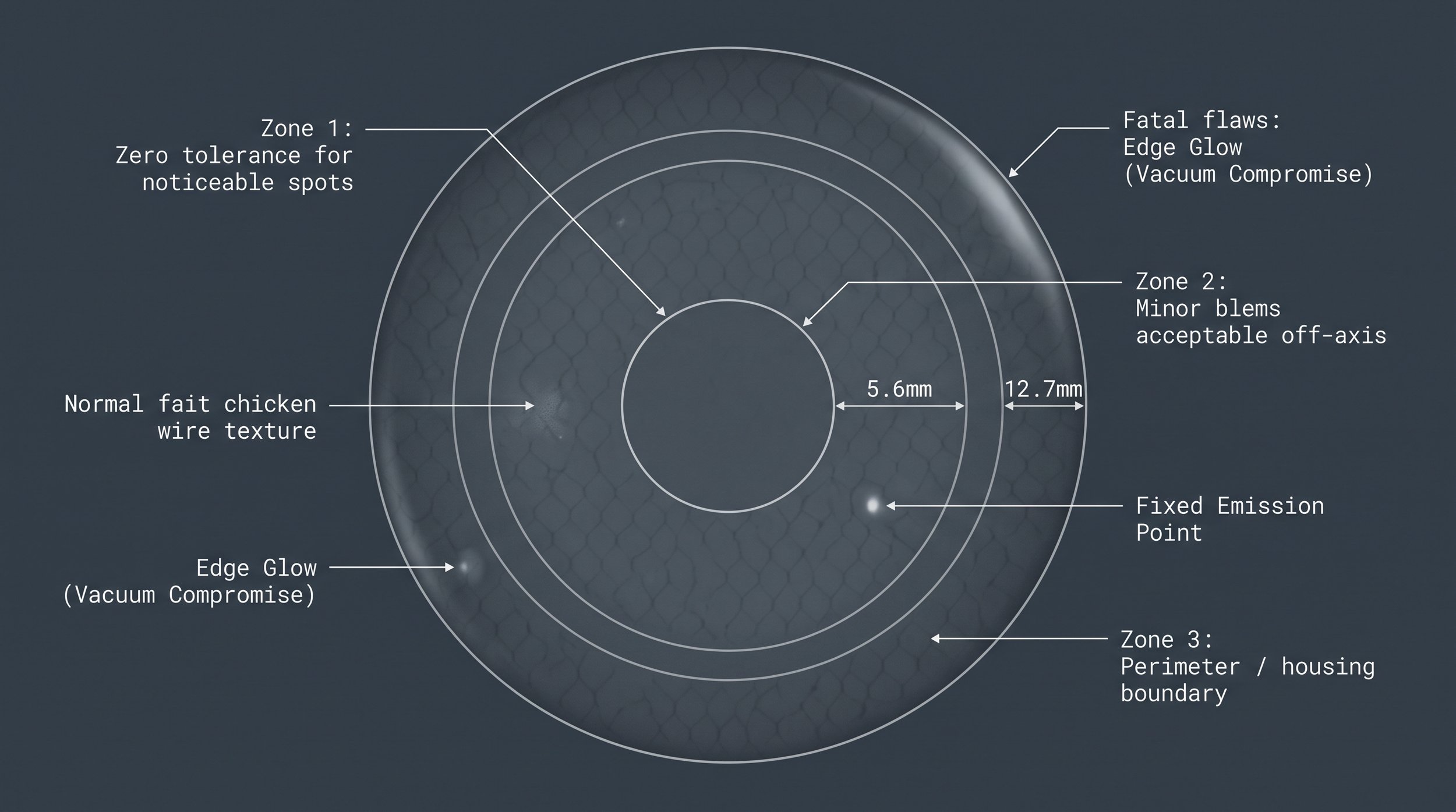
Zone reference for night vision device defect and performance.
| Metric & Unit | What It Actually Measures | Good / Target Range | Sub-Par / Weak Range |
|---|---|---|---|
|
SNR Signal-to-Noise Ratio |
How clean the image is in true darkness. This is the single best predictor of real-world low-light performance. | 28 – 35+ | < 24 |
|
Resolution Line Pairs / mm (lp/mm) |
Optical sharpness and resolving power of fine target detail under adequate light. | 64 – 72 lp/mm | < 57 lp/mm |
|
FOM Figure of Merit (lp/mm × SNR) |
Single combined summary index used for export and contract thresholds. Can mask a weak SNR if resolution is high. | 1800 – 2300+ | < 1400 |
|
EBI Equivalent Background Illumination |
The tube’s internal electronic noise floor with zero light hitting it. Becomes critical in high heat or extreme pitch-black. | 0.1 – 1.0 | > 2.5 |
|
Halo Bloom Ring Diameter (mm) |
Radial size of the flare ring around high-intensity point light sources (streetlights, vehicle headlights, muzzle blast). | 0.5 – 0.7 mm | > 1.0 mm |
|
Photocathode Sensitivity Quantum Efficiency (µA/lm) |
Efficiency of the light-sensitive layer converting incoming photons into free electrons at the front of the tube. | 1800 – 2800+ µA/lm | < 1300 µA/lm |
|
Luminous Gain Amplification Factor (fL/fc) |
Raw multiplication ratio between light entering the objective lens and light exiting the phosphor screen. |
40k – 80k
SuperGain: 100k–120k
|
< 20,000 |
| Zone / Defect | Technical Identification | Operational Impact | Verdict |
|---|---|---|---|
| Zone 1 Center (Ø 5.6 mm) |
Direct line of sight / primary optical axis where passive dots and targets align. | High visual distraction; covers fine target detail and aiming reticles. | Avoid Major Blems |
| Zone 2 Middle (5.6 – 12.7 mm) |
Intermediate scanning field outside direct bore axis. | Minor spots blend out during head movement and active scanning. | Acceptable Value |
| Zone 3 Perimeter (> 12.7 mm) |
Peripheral boundary area immediately adjacent to housing rim. | Almost zero functional impact during real-world navigation and shooting. | Value Sweet-Spot |
| Chicken Wire Fiber-Optic Web |
Faint hexagonal grid visible under flat or bright ambient lighting. | Physical structure of the fiber-optic inverter bundle; zero optical detriment. | 100% Normal |
| Scintillation Electronic "Snow" |
Sparkling/dynamic static across field of view in near-total darkness. | Tube running at peak gain to amplify scarce photons; image is functioning as intended. | Normal Function |
| Edge Glow Boundary Flare |
Persistent glowing crescent or halo creeping inward from the edge. | Indicates loss of internal vacuum or power supply failure; progressive degradation. | Fatal Flaw (Pass) |
| Emission Point Fixed Bright Pinpoint |
Permanent bright pinpoint visible with objective cap on in complete darkness. | Electrical micro-arcing on the MCP surface; causes continuous phosphor burn. | Fatal Flaw (Pass) |
| Shading Density Gradient |
Dark drop-off or uneven gray gradient across half the field of view. | Incomplete photocathode deposition or failing emission; dead visual sector. | Fatal Flaw (Pass) |
FOM isn't the only factor: FOM is just resolution multiplied by SNR, which means two very different tubes can post the same FOM number. A tube with 72 lp/mm resolution but 22 SNR can hit a FOM of ~1584 — and still look worse in the woods at midnight than a 64 lp/mm / 30 SNR tube with a FOM of 1920. If you're choosing between two tubes and can only look at one number, look at SNR. It's the closest single proxy for "how does this actually perform in the dark," which is the entire point of the device.
"Mil-Spec": the historical floor has been FOM 1600+ with SNR 28+ and resolution 64+ lp/mm — lower than the "good" range above, which reflects a genuinely strong tube, not the minimum bar. That floor has also moved over time; mil-spec requirements have reportedly tightened to FOM 2000+ as of August 2025. If you really want to dig into it, it's worth asking your manufacturer what their military procurement spec is although they may or may not release that to you.
Don’t feel like you have to be an expert on the technical side of things, or that it has to be “just right”. Just know what you’re getting and what your money is worth!
White phosphor vs. Green phosphor
White vs. green phosphor isn't actually a device performance metric or feature; it's more of a human perception one and can very much vary from person to person. Although there are some tradeoffs that generally hold true:
Green (P43) peaks at a wavelength your eye's night vision is naturally most sensitive to, so it reads as brighter. It's also been around longer and is historically cheaper.
White (P45) gives a cooler, monochrome image. The performance argument for it is real but subtle: your brain processes grayscale contrast differently than green, and a lot of people find it faster to pick detail out of a white phosphor image over a long session, with less eye fatigue.
What phosphor color does not do: change the tube's actual gain, resolution, or SNR. A green and white tube built to the same spec amplify light identically. You're paying for the viewing experience, not the underlying performance. Decide based on personal preference and budget, not because one is "better" in a technical sense.
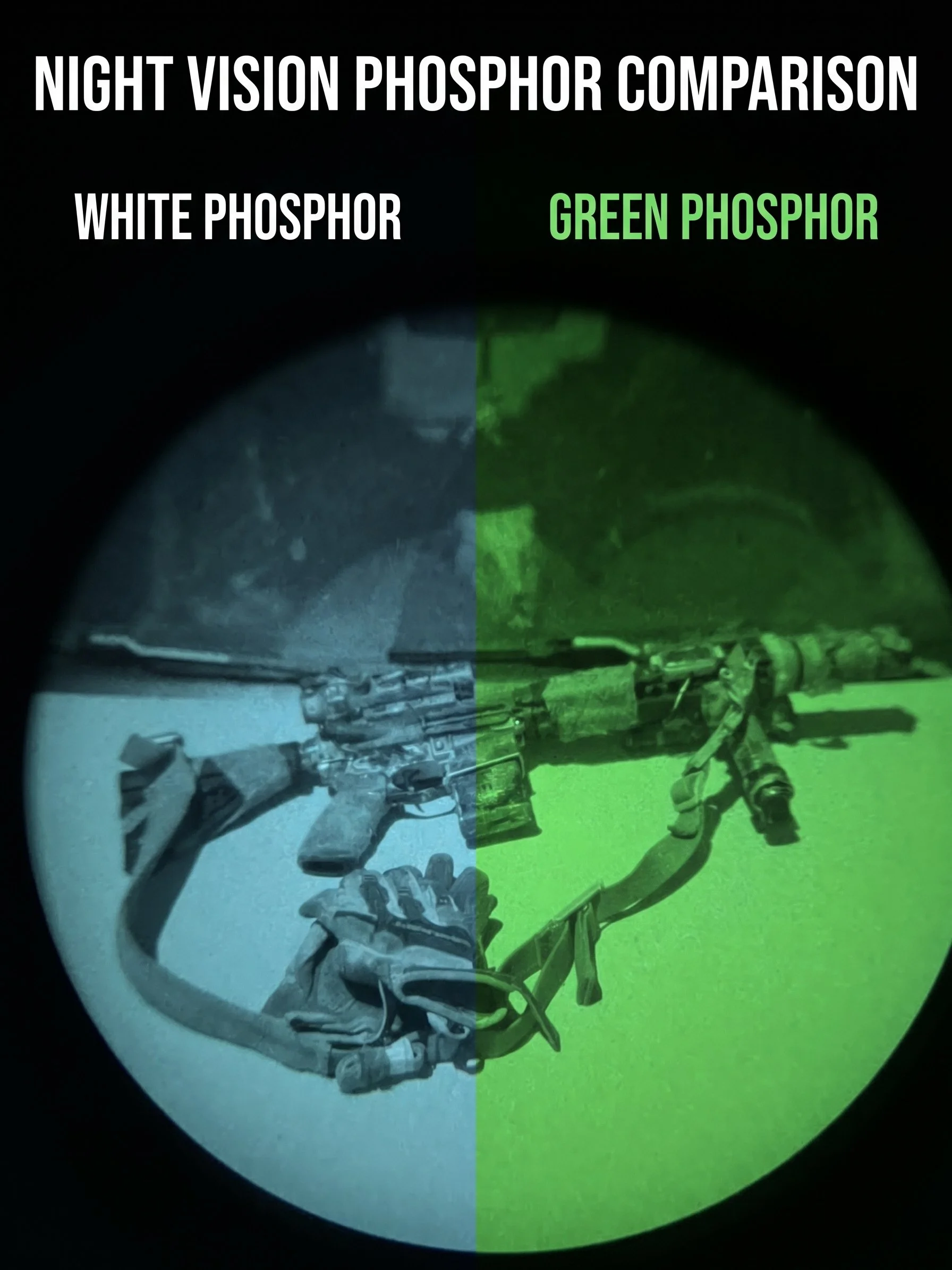
The same image taken through two ~$2400 PVS-14s.
Grading systems and "Mil-Spec"
Manufacturers build to a target spec, then sort ("bin") the output based on how each tube actually performs and how clean it looks cosmetically. Roughly:
- L3Harris: UM/UA designators indicate minimum FOM thresholds (18UM, 20UM, 22UM, 24UM), with UA meaning aviation-grade tolerances. Below mil-spec, tubes get sold as "1701" or commercial grade — often because of one cosmetic defect, not because the tube performs worse.
- Elbit: YH/VH are their mil-spec tiers. PH, SLH, and XLSH are commercial grades — an XLSH tube can have genuinely excellent specs and still land in that bucket because of a single spot outside the military tolerance zone.
- Photonis: 4G/4G+ are their top Gen 2+ tiers, with ECHO/ECHO+ below that.
The actual trap: a seller advertising "mil-spec" without producing the individual tube's data sheet. Mil-spec is a set of numbers a specific tube either does or doesn't meet — it's not a marketing category. Always ask for the data sheet. If a dealer won't produce one, that can be a red flag.
The upside of this system for buyers: a commercial-grade tube (1701, XLSH, etc.) can have specs equal to or better than a mil-spec tube, and cost meaningfully less, because it got bucketed down for a cosmetic reason that may not matter to you at all. This is where you can genuinely find value if you know what to look for.
What's a defect and what's normal
Every tube has some level of imperfection. Here's how to tell the difference between normal manufacturing artifacts and an actual problem:
Normal, don't worry too much:
- Small dark spots (under ~0.003") outside the very center of the image, in reasonable numbers
- "Chicken wire" — a faint hexagonal pattern visible in bright ambient light. This is the physical structure of the fiber-optic bundle inside the tube. Every tube has it.
- Scintillation ("sparkle" or "snow") in genuinely dark conditions — this is the tube doing its job at high gain
More of a "blem" or "used" cost tradeoff:
- Dark spots inside the very center of your field of view — annoying but often not a functional dealbreaker unless there are several
- Mild edge dimness
Avoid it:
- Edge glow — a persistent bright ring at the perimeter of the image. This means the vacuum seal or high-voltage integrity is compromised, and it will get worse.
- Emission points — a fixed, bright pinpoint of light visible even with the lens capped in total darkness. Not the same as scintillation. This is a hardware defect.
- Shading — an uneven dark gradient across a large section of the image, not tied to lighting conditions. Indicates a manufacturing or processing defect.
If you're buying used, ask specifically about these. "Any spots?" isn't a useful question — "any edge glow, emission points, or shading?" is much more informative.
We'll expand this as the technology moves — Gen 2+ in particular is closing the gap on Gen 3 faster than it used to. If something here is out of date or you've got a data sheet question we didn't cover, reach out to info@toadworx.com.
