Intro to Night Vision
By the Toads
If you're brand new to this — you just bought your first tube, or you're still deciding whether to — welcome! This one's for you. Everything else on this page assumes you already know roughly how this stuff works. This article is where "roughly how this stuff works" comes from.
This article is short on purpose, and the other pages are there for you to dive into.
How Night Vision Works
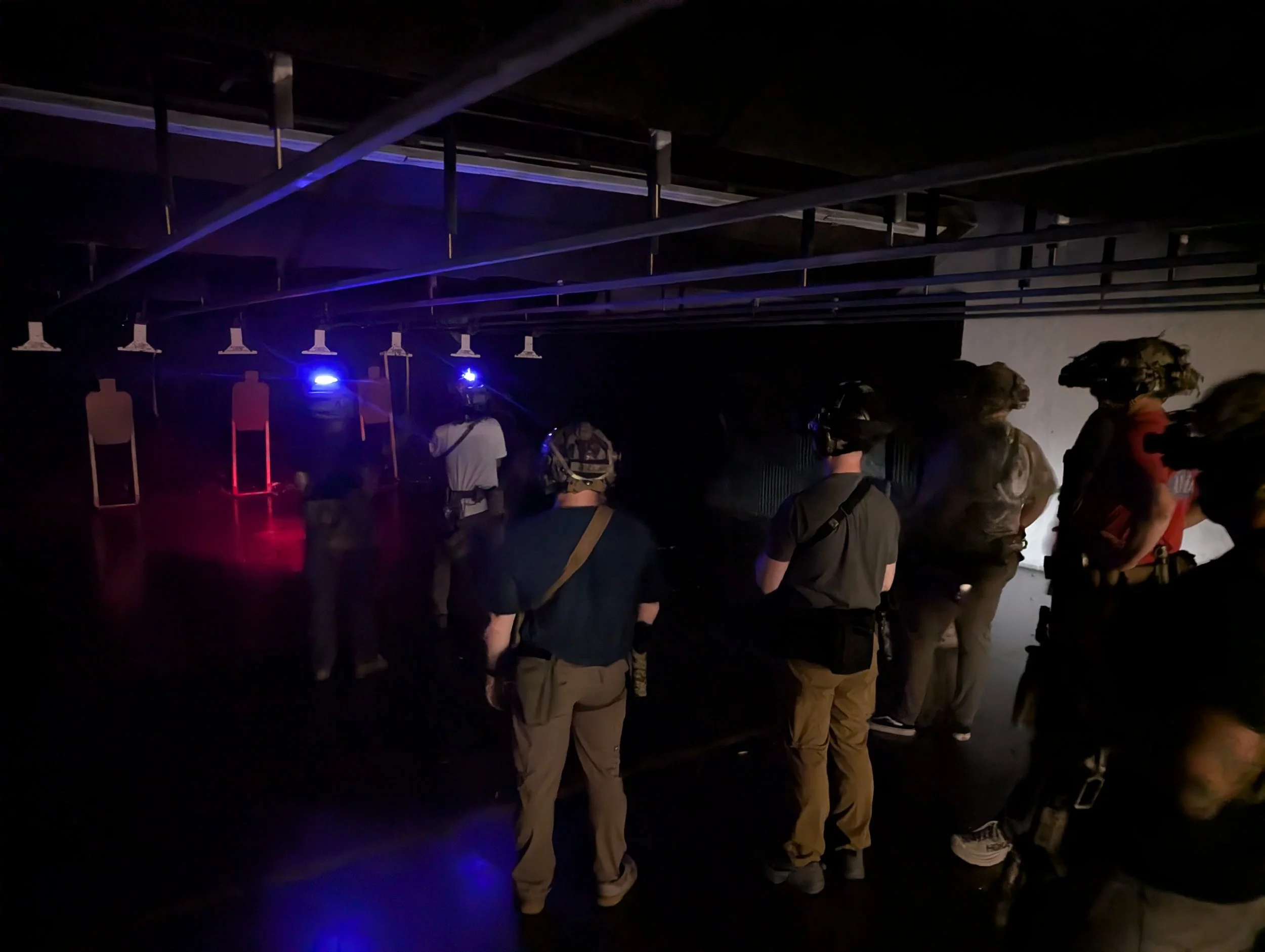
A night vision device doesn't create light out of nothing, and it doesn't see heat — that's thermal imaging, a completely different technology. What a NOD (night observation device) or "night vision goggle" does is take the small amount of light that's already there — starlight, moonlight, etc. — and amplify it thousands of times until your eye can use it.
Inside the tube, incoming light hits a photocathode, gets converted into electrons, and those electrons get multiplied by a component called a "microchannel plate" before striking a phosphor screen that turns them back into an image you can see. That's the whole trick. You can find more detail on tubes in our post here: Tube Deep Dive
On a clear night with some moon or starlight, a good tube works extremely well on its own. The problem shows up when there's genuinely no (or very, very, very little) ambient light to amplify — a new moon, heavy overcast, deep tree cover, or indoors. At that point there's nothing left to multiply, and the tube goes dark no matter how good it is.
That's where active infrared comes in.
Where a LAM Comes In
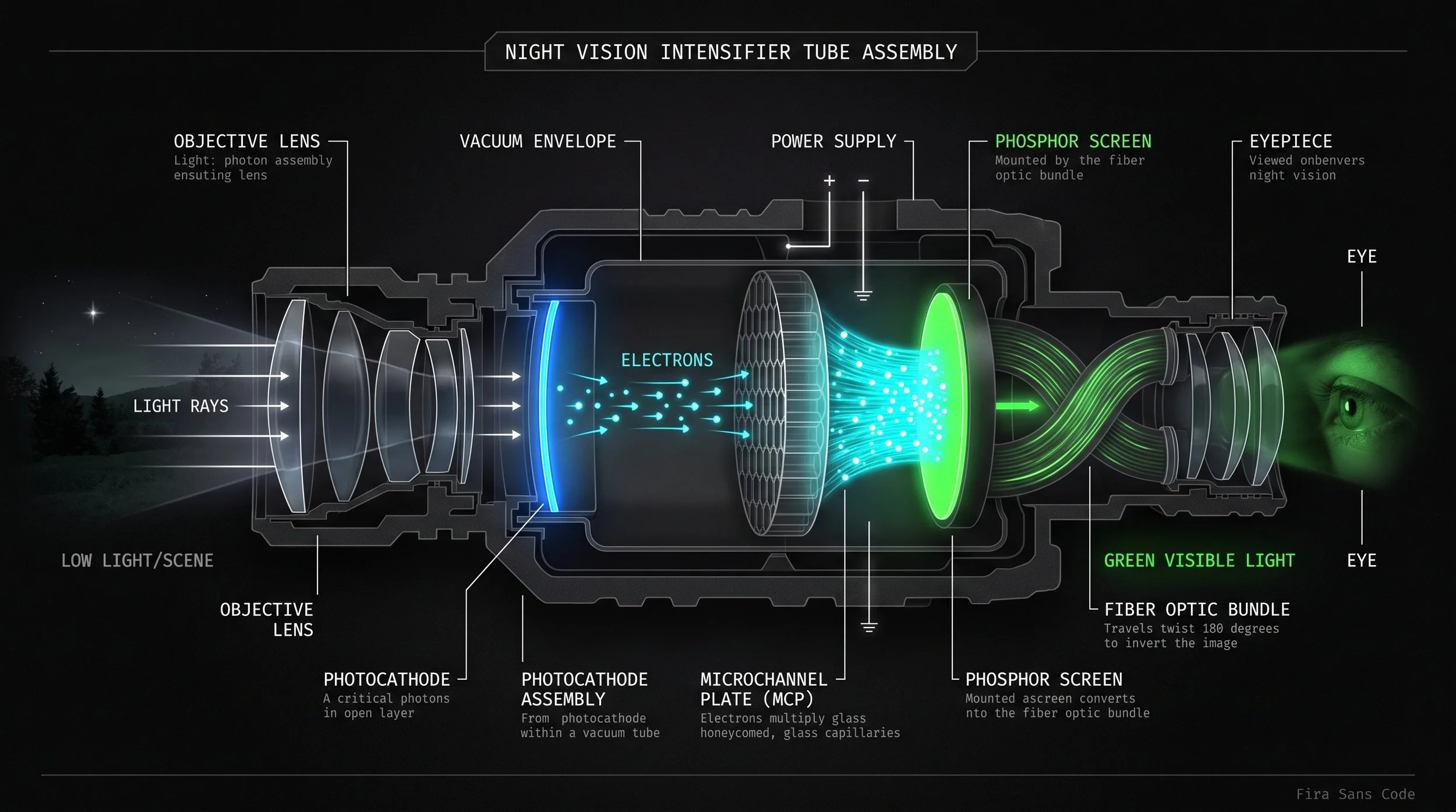
An IR illuminator is essentially an infrared flashlight — invisible to the naked eye, but bright as day to anything wearing NODs. When there's no ambient light left to amplify (or you need more light in a particular spot), the illuminator floods the scene with infrared light for the tube to pick up instead.
Most LAMs (laser aiming modules) combine two separate functions in one housing: an IR laser for aiming, and an IR illuminator for lighting the scene. They're doing two different jobs. The laser puts a precise aiming point on target. The illuminator just lights things up generally, the way a flashlight would, except only visible to NODs.
You don't always need the illuminator running. In good ambient light, most experienced users spend more time passively aiming — using the tube's natural amplification and a red dot or similar optic — than actively running a laser. The illuminator earns its keep specifically when ambient light runs out, and the IR pointer is especially useful for "closer" engagements of about 100m and in. Of course there are exceptions, and individual proficiencies go a long way, but this is generally the case.
We go deep on how to actually pick a LAM, what the specs mean, and where the market breaks down by tier in the LAM Market Map
White Light
White light — a normal flashlight or weapon light — is a completely different tool with a completely different tradeoff. In our opinion it's important to have one as there are definitely environments that NODs just aren't the right fit for. Sometimes you literally just need to find something you dropped on the ground. Or you're operating in that period of twilight or late afternoon where shadows make identification difficult but it's just too bright for NODs. Your mileage may vary.
Neither tool - NODs or white light - is strictly better. They solve different problems, and most serious setups carry both for a reason.
What Night Vision Can and Can’t Do
As awesome and video game-like as night vision is, this is the part Hollywood and video games get wrong.
Detecting that something is out there — a shape, movement, a silhouette — a decent setup can do well up to about 200m or so, sometimes considerably further depending on light and terrain.
Identifying what that something actually is — an animal versus a person, a shape you recognize versus a shape you don't — is a much shorter distance. For most people, on most nights, with a solid setup, that realistically tops out somewhere around 75 to 150 yards. That gap between detection and identification is one of the most consistent things we've heard from every serious user we've talked to, our own firsthand professional and civilian experience, and it's worth internalizing before you ever pick up a rifle at night: seeing something is not the same as knowing what it is.
A few other limitations worth knowing going in:
- Field of view is narrow. Standard monoculars give you roughly a 40° cone of vision — noticeably narrower than normal eyesight. It takes some getting used to.
- Depth perception suffers, especially on a single-tube monocular. Dual-tube setups help, but it's still not the same as unaided vision.
- Weather matters. Fog, heavy rain, dust, and smoke scatter light and can meaningfully cut your effective range, especially when you're relying on an IR illuminator.
None of this makes night vision less useful. It just means going in with realistic expectations about what you're actually going to see, and at what distance you can trust what you're seeing enough to act on it.
Other Limitations To Know About
- Field of view is narrow. Standard monoculars (like a PVS-14) give you roughly a 40° cone of vision — noticeably narrower than normal eyesight. It takes some getting used to.
- Depth perception suffers, especially on a single-tube monocular. Dual-tube setups help, but it's still not the same as unaided vision.
- Weather matters. Fog, heavy rain, dust, and smoke scatter light and can meaningfully cut your effective range, especially when you're relying on an IR illuminator.
None of this makes night vision less useful. It just means going in with realistic expectations about what you're actually going to see, and at what distance you can trust what you're seeing enough to act on it.
Where to Go Next
If you want deeper versions on many of the topics covered above:
Night Vision Tubes, Explained - Generations, metrics that matter, and telling a good tube from a bad one
LAM Market Map - how IR lasers and illuminators break down by price, origin, and what you’re getting
NV Glossary - Quick reference for every acronym. Probably.
